Welcome to Dongguan Dean Testing Co., Ltd. Hotline: 0769-81666160(Headquarters) 0769-88087383(Testing Department)

 Home > Our Services > Asian Certification > BIS Certification in India
Introduction
BIS certification is a product certification in India, regulated by the Bureau of Indian Standards (BIS). Depending on the type of product, BIS certification is divided into three types: mandatory ISI logo certification, CRS certification, and voluntary certification. The BIS certification system has a history of over 50 years, covering more than 1000 products. Any product listed on the mandatory list must obtain BIS certification (ISI mark registration certification) before it can be sold in India.
BIS is a third-party certification body, and products certified by it will be labeled with ISI. This label has a wide influence in India and surrounding countries, and has a good reputation, which is a reliable guarantee of product quality. Once a product is labeled with the 'ISI logo', it means it complies with relevant Indian standards, and consumers can purchase with confidence.
India began implementing a product certification system in 1955 to unify product regulatory standards and requirements, ensure product quality and safety. According to the BIS Act 1986, product certification in India follows the principle of voluntary certification. However, considering factors such as public health and safety, as well as mass consumption, the Indian government enforces mandatory certification for specific products by issuing immediate regulations. Intended to provide end consumers with quality assured, safe and reliable products. All products included in mandatory certification must obtain a product certification certificate in accordance with Indian product standards before entering the market. Therefore, production companies that want to enter the Indian market need to have an understanding of India's product certification system.
Introduction to Bureau of Indian Standards (BIS)
According to the BIS Act 1986, the Bureau of Indian Standards (BIS) is the regulatory body for standardization and certification in India, responsible for product certification work. It is also the only product certification body in India, officially established in 1987 to replace the Indian Standards Institute established in 1946.
The Bureau of Indian Standards (BIS) is under the Ministry of Consumer Affairs and Public Distribution. Although it is a social legal entity, it exercises government functions and its main task is to develop and implement national standards; Implement a qualification assessment system; Representing the country in international standardization activities such as ISO and IEC. The Bureau of Indian Standards (BIS) is a financially independent organization that certifies revenue as its primary source of income. BIS has 5 regional bureaus and 19 sub bureaus. Regional bureaus supervise corresponding sub bureaus. The 8 laboratories under BIS and some independent laboratories are responsible for the inspection of samples taken during the product certification process. These laboratories are operated in accordance with ISO/IEC 17025:1999.
Certification precautions
The validity period of BIS certification is 1 year, and applicants must pay an annual fee. An extension can be applied for before the expiration date, at which point an extension application must be submitted and the application fee and annual fee must be paid.
2. BIS accepts CB reports issued by valid institutions.
If the applicant meets the following conditions, certification will be faster.
a. Fill in the factory address in the application form as the manufacturing factory
b. The factory has testing equipment that meets relevant Indian standards
c. The product officially meets the requirements of relevant Indian standards
Certification classification
At present, BIS certification is divided into three categories:
1. Compulsory ISI mark type certification (product testing+initial factory inspection+post certification supervision), mainly including cement, food, automotive parts, steel products and other major categories;
2. The BIS Compulsory Registration System (CRS) (product testing+post certification supervision) mainly includes tablet computers, microwave ovens, wireless keyboards, printer power adapters, LED lights, lithium batteries, mobile power banks, mobile phones and smart card readers, uninterruptible power supplies/inverters with ≤ 10kVA, rear projection/LCD/LED televisions with 32 inches and below size, etc;
3. The rest of the products are BIS voluntary certification, mandatory mark certification, and registration certification that can be applied for.
Applicable product scope
BIS has issued over 30000 product certification certificates, and manufacturers are allowed to affix ISI labels after obtaining the certificates The scope of certification covers almost every industrial field, such as agricultural products, textiles, electronics, etc.
List of mandatory certified products:
The first batch (MANDATORY)
BIS certification is applicable to manufacturers in any country, and the main certification areas include:
1. Tires; 2. Household appliances such as electric irons, water kettles, electric stoves, and heaters; 3. Cement and concrete; 4. Circuit breaker; 5. Steel; 6. Electric energy meter; 7. Automotive parts; 8. Food and milk powder; 9. Bottle; 10. Tungsten filament lamp; 11. Oil pressure furnace; 12. Large transformers; 13. Plug; 14. Medium and high voltage wires and cables; 15. Self regulating light bulb. (Compulsory in batches since 1986 until now)
The second batch (COMPULSORY)
There are mandatory registration products for electronic information technology equipment, including:
1. Set top box; 2. Portable computers; 3. Notebook; 4. Tablet computer; 5. Monitors with a screen size of 32 inches or larger; 6. Video monitor; 7. Printers, plotters, and scanners; 8. Wireless keyboard; 9. Telephone answering machine; 10. Automatic data processor; 11. Microwave oven; 12. Projector; 13. Electronic clocks powered by live grid sources; 14. Power amplifier; 15. Electronic music system (mandatory from March 2013)
The second batch of additions (COMPULSORY)
16. IT equipment power adapter; 17. AV equipment power adapter; 18. UPS (uninterruptible power supply); 19. DC or AC LED module; 20. Battery; 21. Self regulating LED lights; 22. LED lighting fixtures; 23. Mobile phone; 24. Cash register; 25. Selling terminal equipment; 26. Copier; 27. Smart card reader/writer; 28. Postal processing machines, automatic stamping machines; 29. Passport reader; 30. Mobile power bank. (Mandatory from November 2014)
Application Process
1. Customers provide information and samples to testing agencies
2. Testing agencies conduct structural inspections on products and prepare relevant documents for certification applications?
3. Will the testing agency send the samples to the cooperative laboratory in India?
4. Sample testing
5. Indian cooperative laboratory issues BIS test report
6. The testing agency provides registration documents, Indian representatives, and test reports to apply for registration with BIS
7. BIS approves and issues a registration authorization letter?
8. The customer obtains the BIS registration number of the product and follows up on registration and evidence collection
application materials
1. Application Form;
2. Proof of appointment form for local agents in India, or proof of manufacturer's Indian office, as well as a permit from the Reserve Bank of India;
3. Documents proving the establishment of the company, such as a registration certificate;
4. Process flowchart, illustrating the entire manufacturing process of the product, from raw materials to finished products;
5. Quality control system (such as quality manual, quality control plan, testing arrangement, etc.);
6. If available, provide other detailed information on product or system certification;
7. If available, provide detailed information on the components or raw materials used for product manufacturing before certification;
8. List of machines used for production and manufacturing;
9. List of testing equipment during the testing process;
10. Product design drawings;
11. Qualification certificates and detailed experience of laboratory supervisors, technical and QC staff;
12. Test reports from accredited independent laboratories or factories' own laboratories;
13. The layout diagram of the factory clearly shows the main production machines, laboratories, etc;
14. A traffic diagram near the factory, a diagram of the route from the nearest airport or train station to the factory, and a detailed explanation of the route from India to the factory;
15. Bill of exchange receipt
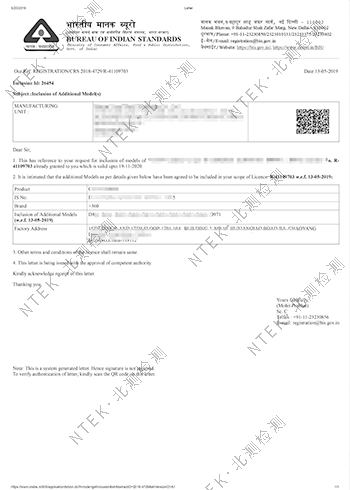
Certificate Information

Copyright © Dongguan Di'en Testing Co., Ltd. Technical Support: Dongguan Guangsu Network Guangdong ICP No. 15086094-1
Mailing Address: Di'en Testing, Wusha Community, Chang'an Town, Dongguan City
Metrology & Calibration Contact:
Mr. Tai - Mobile: 13760389645
Ms. Li - Mobile: 15817661429
Product Testing Contact:
Ms. Yang - Mobile: 18123900885
Reliability, Failure Analysis, & Materials Testing Contact
Mr. Ye - Mobile: 13613003484
Copyright © Dongguan Di'en Testing Co., Ltd. Technical Support: Dongguan Guangsu Network Guangdong ICP No. 15086094-1