Welcome to Dongguan Dean Testing Co., Ltd. Hotline: 0769-81666160(Headquarters) 0769-88087383(Testing Department)

 Home > Our Services > African Certification > SABS Certification in South Africa
Introduction
The South African Bureau of Standards (SABS) was established under the National Standards Act 1945 and is under the jurisdiction of the South African Department of Trade and Industry. SABS is a neutral third-party certification body in South Africa, responsible for system certification and product certification in South Africa. In addition to the responsibility of formulating standards, SABS also represents national management standards and grants the right to use logos for products that comply with the standards. The SABS Mark has been widely used in various fields and has become a symbol of product quality assurance.
Certificate Description
1. There are two types of certification in South Africa: the first type is LOA and COC, which are mandatory for South African imports, and this certification process does not allow the SASB trademark to be affixed to the product label. This type of application does not require factory inspection; The second type of application is based on the first type of application, which allows for the reapplication for the use of SABS Mark. The use of this mark requires a series of factory inspection procedures, which are costly, and a certain amount of annual fees and factory inspection fees must be paid each year as the right to use the mark.
2. COC is EMI testing, LOA is the approval of the Letter of Authority agent, apply directly to South Africa.
Scope of Certification
SABS certification is divided into two categories: product certification and system certification. SABS product certification mainly includes the following eight categories: chemical products, biological products, fiber products and clothing, mechanical products, safety equipment, electrical products, civil and construction, and automotive products. Among them, the building materials and products involved include: stone products, concrete products, roofing materials, cement, lime, cement mixtures, natural building stones, safety glass, steel structures, wood and wood products, bricks, tiles, paints, coatings, sealants, etc.
Application Process
1. The manufacturer fills out the complete application form
2. If the factory has more than one building, a separate application form needs to be filled out. Each product within the scope of certification is required to be reflected on the application form. In addition, the factory also needs to fill out an application form for the credibility of the person in charge, who must guarantee the first review fee and other certification fees;
3. After receiving the application form, the South African Bureau of Standards will issue a reviewed quotation;
4. On the premise that the quotation is approved, the South African Bureau of Standards will conduct a factory inspection;
5. If the above review is approved, the South African Bureau of Standards will prepare an annual supervision contract;
6. There will be two auditors conducting random audits every year, and the cost of annual supervision and testing will be specified in the contract;
7. Two auditors will randomly check the samples and bring them back to the laboratory;
8. In the future, the South African Bureau of Standards will extract samples from the goods of sellers in South Africa. If the batch of goods is less than 4 times per year, the insufficient samples will be sent out from the factory, and the cost will be borne by the factory;
9. If the test result is unqualified, the cost of the sample and retesting will be borne by the factory;
The validity period of the certificate will be three years, unless the certificate is cancelled for other reasons.
Explanation of South African Certification Body
1. NRCS: It is the issuing authority for LOA certificates.
2. SABS: It is the issuing authority for COC certificate and SABS logo certification. South African Bureau of Standards (SABS)
Responsible for braking South African standards, while also engaged in certification and testing work.
3. LOA certification: Letter of Authority, targeting security aspects.
4. COC certification: Certificate of Compliance, specifically for EMC.
5. SABS certification: This certification is voluntary. The requirements are quite strict, requiring the South African Bureau of Standards (SABS) to arrange factory inspections and testing, and there will be two annual audits after certification.
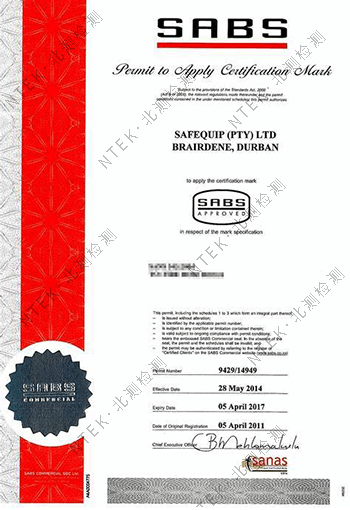
Certificate Information
Precautions
1. Firstly, the enterprise must designate an agent, who will declare responsibility for all data information and after-sales matters. The South African Road Traffic Act (Act 93:1996) requires importers to register with the local Department of Transport;
2. South Africa is an imperial country and a right-hand drive member state. Only after successful registration can testing continue and documents be submitted to SABS and other work;
3. All testing projects should be completed strictly in accordance with relevant South African standards, and technical documents such as reports that meet NRCS requirements should be submitted;
4. The entire certification process consists of two parts: test report review and sample consistency check; (Note: Sample inspection can be arranged domestically or in South Africa according to the needs of the enterprise)
5. Once all materials and samples have passed NRCS's review and evaluation, NRCS will issue a certificate. Generally, the entire review process does not exceed 15 working days.
6. Certificate Validity Date: As long as the applicable standards and regulations have not changed and the sample has not been modified, the certificate will remain valid;
7. NRCS will be responsible for production consistency control, and if a sample model is found to be inconsistent, it has the right to revoke the certificate.
8. To ensure production consistency, NRCS may conduct a factory audit after a certain period of time following the certificate application.
Comparison between NRCS and SABS
Certification Type | regulatory agency | accredited laboratory | Test Standard | Factory Inspection | |
NRCS | mandatory | NRCS | ILAC | Acceptable IEC | none |
SABS | voluntary | SABS | N/A | Only SABS | have |
Copyright © Dongguan Di'en Testing Co., Ltd. Technical Support: Dongguan Guangsu Network Guangdong ICP No. 15086094-1
Mailing Address: Di'en Testing, Wusha Community, Chang'an Town, Dongguan City
Metrology & Calibration Contact:
Mr. Tai - Mobile: 13760389645
Ms. Li - Mobile: 15817661429
Product Testing Contact:
Ms. Yang - Mobile: 18123900885
Reliability, Failure Analysis, & Materials Testing Contact
Mr. Ye - Mobile: 13613003484
Copyright © Dongguan Di'en Testing Co., Ltd. Technical Support: Dongguan Guangsu Network Guangdong ICP No. 15086094-1