Welcome to Dongguan Dean Testing Co., Ltd. Hotline: 0769-81666160(Headquarters) 0769-88087383(Testing Department)

 Home > Our Services > European Certification > GS Certification in Germany

Introduction
The meaning of GS is German "Geprufte Sicherheit" (safety certified), also known as "Germany Safety". GS certification is a voluntary certification based on the German Product Safety Law (GPGS) and tested in accordance with the EU unified standard EN or German industrial standard DIN. It is a recognized German safety certification mark in the European market.

The GS certification mark indicates that the safety of the product has been tested by a credible independent organization. The GS certification mark, although not mandatory by law, can indeed subject manufacturers to strict German (European) product safety laws in the event of product failure causing accidents. So the GS certification mark is a powerful market tool that can enhance customers' confidence and purchasing desire. Although GS is a German standard, the vast majority of European countries recognize it. Moreover, while meeting the GS certification, the product will also comply with the CE marking requirements of the European Community. Unlike CE, there is no legal requirement for the GS certification mark. However, as safety awareness has penetrated into ordinary consumers, an appliance with the GS certification mark may have greater competitiveness in the market compared to ordinary products. Usually, GS certified products have a higher selling price and are more popular.
Certification significance
The necessity of GS certification
1. GS, as a symbol of product safety and reliable quality, has gained wider recognition from German and EU consumers;
2. Maximizing the reduction of responsibility risks for manufacturers in terms of product quality;
3. Enhance the confidence of manufacturers in product quality, safety, and compliance with legal requirements;
4. Emphasize to consumers the manufacturer's obligation to ensure product quality and safety;
5. Manufacturers can ensure to end users that products bearing the GS logo have passed testing by third-party testing agencies;
6. In many cases, products labeled with the GS logo exceed the legal requirements in terms of quality and safety;
7. The GS mark can receive higher recognition than the CE mark because the GS certificate is issued by a third-party testing agency with certain qualifications.
Applicable product scope
1. Household appliances, such as refrigerators, washing machines, kitchen utensils, etc.
2. Household machinery.
3. Sports equipment.
4. Household electronic devices, such as audiovisual equipment.
5. Electrical and electronic office equipment, such as copiers, fax machines, shredders, computers, printers, etc.
6. Industrial machinery and experimental measuring equipment.
7. Other safety related products such as bicycles, helmets, ladders, furniture, etc.
Application Process
1. Application: The applicant shall submit the required documents. For electrical products, it is necessary to submit the final assembly drawing, electrical schematic diagram, material list, product usage or installation manual, and explanation of differences between series and models.
2. Sample testing: The testing will be conducted in accordance with applicable standards and can be carried out in any laboratory of the manufacturer or inspection agency stationed in various countries.
3. Factory inspection: GS certification requires safety related procedural inspections to be conducted on the production site.
4. Issue GS certificate.
application materials
1. Application Form
2. General Agreement
3. CB certificate and report of the product
4. Product User Manual
5. Parts List
6. Circuit diagram and layout
7. Product structure diagram
8. Specifications for Transformers and Other Components
9. Nameplate
10. Electromagnetic Compatibility Assessment Report (EMC) and Factory Declaration of Conformity (DOC)
11. German manual
12. Samples during the shipment period
Certificate Information
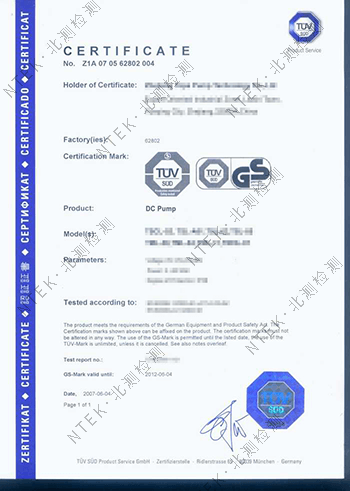
Difference between GS certification and CE certification
GS certification | CEcertification |
Voluntary certification of non mandatory | Compulsory certification |
Applying German safety regulations for testing GS | Applicable European standards (EN) for testing |
Testing and issuance of GS mark certificate by an independent third party authorized by the German government | CE can be self declared on the premise of having complete technical documents (including test reports) |
Annual fee must be paid | No annual fee required |
Factory inspection must be conducted annually | No factory inspection required |
Authorized testing units are responsible for issuing the GS logo, which has high credibility and market acceptance | The factory's self declaration of product conformity has low credibility and market acceptance |
Improving the reputation of product quality is of great help | There is no way to improve product quality |
Accepted by a large number of customers in Europe | Generally accepted by customers in Europe |
Slightly higher cost | The cost is generally |
The usual duration is 6-8 weeks | The usual duration is 2-4 weeks |

Copyright © Dongguan Di'en Testing Co., Ltd. Technical Support: Dongguan Guangsu Network Guangdong ICP No. 15086094-1
Mailing Address: Di'en Testing, Wusha Community, Chang'an Town, Dongguan City
Metrology & Calibration Contact:
Mr. Tai - Mobile: 13760389645
Ms. Li - Mobile: 15817661429
Product Testing Contact:
Ms. Yang - Mobile: 18123900885
Reliability, Failure Analysis, & Materials Testing Contact
Mr. Ye - Mobile: 13613003484
Copyright © Dongguan Di'en Testing Co., Ltd. Technical Support: Dongguan Guangsu Network Guangdong ICP No. 15086094-1